Michael Berg and his father
The ReaderMichael Berg and his father have a relationship shaped by reserve, intellectual distance, and a persistent uncertainty about whether the father can be emotionally present. When Michael later brings him a moral crisis connected to Hanna’s trial, their conversation gives that distance a different function: the father cannot decide for his son, but his account of freedom, dignity, and responsibility helps define what Michael must face. The exchange offers a principle rather than a solution, and its unresolved ending preserves the difficulty of their bond.
Family Life and Emotional Distance
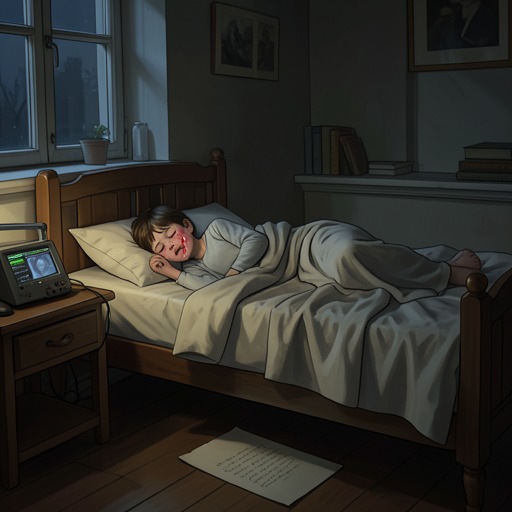
At a family dinner, Michael watches his father consider a question about whether Michael is ready to return to school after illness. The father sets down his knife and fork, leans back, and folds his hands, but says nothing. Michael cannot tell whether he is weighing the family matter or has drifted into work. His father is a professor of philosophy, for whom thinking, reading, writing, and teaching constitute a life; the silence leaves his son unsure whether attention is being given to the family or withheld from it.
Michael sometimes feels that the children are like pets to their father: cared for and perhaps loved, but not the center of his life. He wishes the family were his father’s life, then checks that wish against the children’s own movement toward adulthood. His older brother has had to sleep on the living-room sofa while Michael recovered in their shared bedroom; his younger sister, as the youngest of four, has reason to be cheeky to hold her own. In one evening of heightened awareness, Michael suddenly feels affection for them all and imagines the meal beneath the brass chandelier as their last intimate gathering. He is at once still with his family and already leaving it in feeling, homesick for his parents and siblings while longing for the woman.
The father nevertheless notices the exact form of Michael’s request. When Michael has asked him whether he thinks he should return to school, the father observes that Michael had instead said he was going back the next day. He agrees that Michael can try, with the practical qualification that he can stay home again if it becomes too much. The response is neither a grand declaration of care nor simple indifference: it shows a father who attends closely enough to hear the distinction, while keeping his support measured and pragmatic.
The Father as Philosopher and Parent
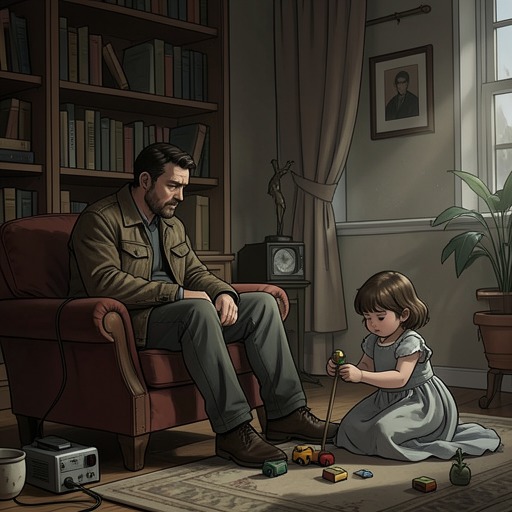
Years later, Michael seeks his father out because he wants to discuss the moral problem arising from Hanna’s trial. He does not turn to him because they are close. The father is undemonstrative, unable to share his feelings with his children or comfortably receive theirs. Michael once imagined a hidden wealth of feeling behind this manner; later he wonders whether those feelings had dwindled through years without expression. Precisely because intimacy is limited, Michael hopes to consult the philosopher who has written about Kant and Hegel and occupied himself with moral questions, rather than risk the inadequacies of the examples he has discussed with friends.
The household has long made the father’s authority feel formal. When the children want to speak with him, he gives them appointments, much as he does his students. He works at home and sees colleagues and students there; visitors wait in the corridor until their turn. His children do not have to wait in the hall when an appointment has been made, but they still have to arrive at the appointed time and knock before entering. The arrangement gives family access to him, yet retains the procedures of his professional world.
The studies in which Michael meets his father reinforce that separation. In an earlier study, whose windows face streets and houses, Hanna once ran her fingers along the books. In the later home, moved into in the early 1960s and retained by Michael’s parents after the children grew up, the windows look over the plain along the Rhine. In both rooms, the view seems framed rather than open: books, papers, thought, and the smoke of pipe and cigars make the study a self-contained world, distinct from what lies outside it. Michael’s father inhabits that world even when his son is admitted into it.
Counsel on Responsibility and Autonomy
Michael presents the problem in abstract terms, using examples rather than naming everything he is not ready to disclose. His father understands that the matter concerns the trial but does not press him to confirm it. Instead, he sits with his head tilted and his hands gripping the arms of his chair, thinking without looking at Michael. The father’s restraint is significant: he recognizes the subject while allowing his son to decide how much to reveal.
His answer begins with the individual’s freedom and dignity and the principle that a person must not be turned into an object. He recalls Michael’s childhood anger when his mother claimed to know better what was good for him, then admits that philosophy has tended to leave children to pedagogy, a field in which they are not necessarily well served. The aside makes the father’s teaching personal without dissolving his reserve; his smile and admission that he forgets his son, as he forgets him “sometimes,” acknowledge the very distance the conversation is trying to cross.
For adults, the father sees no justification for placing another person’s judgment of what is good for them above their own. But autonomy does not make silence an adequate response when responsibility has been inherited or accrued and someone is blind to what may be good for them. In that situation, he says, one must try to open the person’s eyes, while leaving the final word to them. The conversation must be with that person, not conducted behind their back. This distinction gives Michael a demanding course: to speak directly, without claiming the right to choose for Hanna.
The principle does not tell Michael how to speak. He imagines having to tell Hanna that he has recognized the lie she has maintained throughout her life, that she is sacrificing her future to it, and that the lie cannot erase the prison term she deserves for her crimes. He also cannot see how to reveal her illiteracy without offering some vision of a life beyond prison, a future he does not know how to describe. His father’s reasoning clarifies the responsibility but cannot supply the words or remove the conflict between respecting Hanna’s choice and believing that she is acting against her interests.
An Unresolved Exchange
When Michael asks what to do if he cannot speak to the person directly, his father recognizes that the question misses the point: Michael still has to decide. The father stands, explaining that his back hurts, and says he has not been able to help. As a philosopher, he cannot provide the answer Michael sought; as a father, he finds being unable to help his children nearly unbearable. His bodily discomfort and admission make the encounter less like a settled lecture than an imperfect exchange between two people who do not easily communicate.
Michael waits for more, then suspects that his father is making the situation easy for himself. He remembers ways his father could have cared for or helped the children more, but also considers that his father may know this and find it difficult to bear. The moment does not establish which interpretation is correct. Michael feels embarrassed, and senses that his father is embarrassed too. Their mutual discomfort exposes the history beneath the philosophical question: the father’s counsel is useful, but it arrives from a parent whose own failures of closeness remain unaddressed.
The conversation closes without reconciliation or a practical decision. The father says Michael can come at any time, an offer of access that contrasts with the appointments and knocks of the household while stopping short of emotional intimacy. Later, Michael tells a questioner that he had a relationship with Hanna when he was fifteen, and confirms that they slept together. That disclosure places the trial dilemma within his personal history, but the available account does not show his father learning that particular fact. The distinction matters: the father advises Michael about how one should address another person, while the son remains unable to say directly what his dilemma means to him.
The relationship therefore functions as more than a source of advice. The father gives Michael a clear ethical limit—do not substitute one’s judgment for another’s, and do not speak about them behind their back—yet offers no escape from the cost of following it. Their encounter joins a philosophy of respect to the lived shortcomings of family life: the father can articulate responsibility more readily than he can repair intimacy, and Michael can recognize his father’s possible regret without knowing how to answer it.